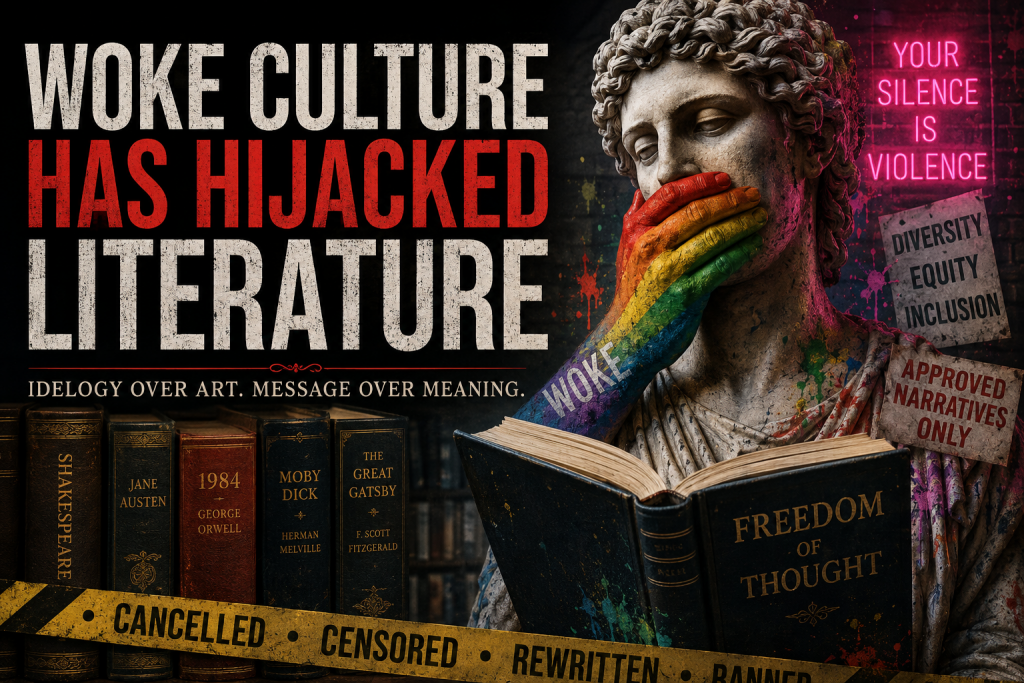
Woke Culture Has Hijacked Literature.
For centuries, literature has challenged power, explored the human condition, and encouraged readers to wrestle with difficult questions. It has never been comfortable, and it has never been politically neutral. Yet today’s literary landscape faces a different problem: literature is increasingly being treated not as an art form to be explored, but as a vehicle for ideological instruction.
What many critics describe as woke culture has transformed the way books are written, published, taught, and judged. Instead of asking whether a novel is beautifully crafted, intellectually challenging, or emotionally profound, the first questions too often become: Is it diverse enough? Does it promote the correct message? Does it reflect contemporary social values?
Art has become subordinate to activism.
From Storytelling to Ideological Messaging
The greatest literature trusts readers to think for themselves. Shakespeare did not tell us whom to admire. Dostoevsky did not provide easy answers. Orwell exposed totalitarianism without reducing his novels to slogans.
Many contemporary works, by contrast, are criticised for feeling less like stories and more like moral lessons. Characters are divided into victims and oppressors, complex conflicts are replaced by ideological binaries, and subtlety gives way to political messaging.
When literature becomes propaganda—regardless of the political direction—it ceases to be great literature.
Why Woke Culture Has No Place in Literature
Literature exists to explore the full complexity of the human experience. It asks difficult questions without guaranteeing comfortable answers. It presents flawed heroes, sympathetic villains, moral ambiguity, tragedy, redemption, and contradiction. Its purpose is not to tell readers what to think but to invite them into the difficult process of thinking for themselves.
This is fundamentally at odds with what many critics describe as woke culture, which they argue tends to divide society into simplified categories of privilege and oppression while encouraging moral certainty rather than intellectual curiosity. When these assumptions become the dominant framework through which literature is judged, artistic freedom inevitably suffers.
The first problem is that literature ceases to be evaluated on artistic merit. Throughout history, the greatest works have endured because of the quality of their language, the depth of their characters, and the universality of their themes. Under an ideological framework, however, these qualities risk becoming secondary to political considerations. Books may be praised or condemned less for what they achieve artistically than for whether they advance approved social messages.
Secondly, ideological literature often discourages complexity. Great authors rarely produce perfect heroes or irredeemable villains. Shakespeare’s Macbeth is both murderer and victim of his own ambition. Milton’s Satan remains one of literature’s most compelling characters precisely because he cannot be reduced to a caricature. The greatest novels challenge readers by refusing easy moral classifications. When every story becomes a lesson about contemporary political categories, literature loses the ambiguity that gives it enduring value.
Another concern is the growing expectation that writers bear social responsibilities beyond simply telling compelling stories. Authors increasingly face pressure to represent particular identities, avoid controversial viewpoints, or anticipate how readers may interpret their work. Such expectations inevitably encourage self-censorship. Writers begin asking not, “Is this true to the story?” but, “Will this provoke outrage?” History shows that genuine literary innovation rarely flourishes in environments where conformity is rewarded and dissent is punished.
Perhaps most troubling is the tendency to reinterpret the literary canon primarily through contemporary political values. The purpose of studying literature is to encounter minds from different places, cultures, and centuries—not to demand that they share twenty-first-century assumptions. The classics are valuable precisely because they reveal how human beings have wrestled with questions of love, justice, ambition, faith, power, and suffering across history. To dismiss them because they fail modern ideological tests is to misunderstand the purpose of literary study.
There is also a broader philosophical concern. Literature should never belong to any political movement, whether progressive, conservative, socialist, nationalist, or otherwise. The moment art is expected to serve a political cause, it risks becoming propaganda. History offers countless examples of governments and movements seeking to harness literature for ideological ends. The result has almost always been a narrowing of artistic freedom and a decline in literary excellence.
None of this means that literature should avoid politics or social criticism. On the contrary, many of history’s greatest works have confronted injustice, challenged authority, and exposed hypocrisy. The difference lies in method. Great literature persuades through story, character, and insight. Ideological literature often seeks to persuade through predetermined conclusions.
Ultimately, literature should remain one of the few places where every idea can be explored, every assumption questioned, and every certainty challenged. It should be a forum for imagination rather than indoctrination, for inquiry rather than orthodoxy. Any ideology that seeks to prescribe what stories may be told, how they should be interpreted, or which conclusions readers ought to reach has stepped beyond criticism and into cultural control.
Literature deserves better. It deserves the freedom to offend, to challenge, to inspire, to confuse, and above all, to remain independent of the political fashions of any age.
Judging the Past by Today’s Standards
One of the most troubling developments has been the tendency to judge classic literature almost exclusively through modern political values.
Books are increasingly introduced with warnings, rewritten to remove offensive language, or criticised because their authors reflected the attitudes of their own time. Rather than engaging with history honestly, there is a temptation to sanitise it.
The purpose of reading the past is not to find people who thought exactly as we do. It is to understand worlds different from our own.
A civilisation that edits its classics instead of debating them risks losing the very historical perspective that literature preserves.
Diversity Should Expand the Canon—Not Replace It
There is nothing objectionable about discovering outstanding authors from a wider range of backgrounds. Great literature can come from any nation, culture, or community.
The problem arises when identity becomes more important than excellence.
If books are selected primarily because they satisfy demographic or ideological criteria, literary merit inevitably becomes secondary. A healthy literary culture expands the canon by adding exceptional works—not by sidelining enduring classics because they fail contemporary political tests.
The Publishing Industry’s New Orthodoxy
Publishing has become increasingly driven by ideological trends. Many writers feel pressure to address fashionable political themes or to frame stories around approved narratives of identity, privilege, and oppression.
This does not mean that every contemporary novel is ideological. It does mean that some authors believe certain viewpoints are more publishable than others, while dissenting perspectives may struggle to find mainstream support.
Literature flourishes through intellectual diversity, not ideological conformity.
The Classroom Should Teach Thinking, Not Agreement
Literature classrooms should expose students to competing interpretations, difficult moral questions, and uncomfortable ideas.
Instead, critics argue that some educational settings encourage students to interpret texts through a narrow set of political frameworks. When one critical lens becomes the default lens, genuine inquiry gives way to ideological expectation.
Students deserve to encounter multiple perspectives and reach their own conclusions—not merely reproduce the conclusions their teachers or institutions favour.
Defending Literature
The strength of literature has always been its refusal to fit neatly into political categories. Great novels provoke, disturb, contradict, and surprise. They ask questions more often than they provide answers.
When literature is judged primarily by its usefulness to a political cause, something precious is lost. Artistic excellence gives way to ideological approval. Complexity gives way to certainty. Debate gives way to conformity.
Whether one agrees with the label “woke culture” or not, the broader concern remains: literature should challenge every orthodoxy—including fashionable ones. The role of books is not to reinforce the ideology of the moment but to enlarge the imagination, deepen understanding, and defend the freedom to think independently.
If literature is to remain one of humanity’s greatest achievements, it must resist being enlisted into any political movement. It should belong to readers, not ideologues.